

If you told me a year ago that I’d be setting my alarm a full half hour before it was already set to make a 7 a.m. gym class on time, I’d have said you were crazy. To wake up even more groggy, under a blanket of San Francisco fog and even in the dark sometimes, sounded about as appealing as boiling a frog for dinner. Alas – I’m now rising with the sun, and even earlier some days, to scribble three pages of longhand before I get on with my day.
Why did I start this practice, and what keeps me returning to the page?
It’s not to sound writerly, or to create anything of meaning. It’s simply to get to the other side.
Let me explain. Julia Cameron, and her best-selling Artist’s Way, believes that to show up to the page to do our real writing we must first clear the clutter from our heads. Mental clutter is the stuff we hold onto without realizing how much real estate it takes up – things like laundry and pet store and even researching grad programs. It’s chatter that cycles through our minds day after day.
Holding onto task lists and cycling through the same content can stall us, Cameron argues, and pages give us space to put those things down. They reduce the chance that the mundane seeps into our work, too, expediting originality in our creative process.
I’ve found this to be true – and in addition to helping me clear out the gunk before I get to the stuff I really want to be writing, morning pages help me see exactly what my next steps need to be, in my creative work and in my life.
Take an example. If I’ve complained about clogged sinuses for days, I know it’s time to get antihistamines and the air filter that’s sitting in my Amazon cart. If new towels have been on my list for a week, I know it’s time to finally pick them up.
Then there’s the bigger stuff: If I’ve been noticing that the deep, rich conversations I’ve been having with women are providing me a tremendous source of meaning, is there a way I can center them even more in my life? bring more rigor to the way I navigate them? Would training or further education benefit me? Are there books I can read, or people I can speak with about their paths toward coaching, even therapy?
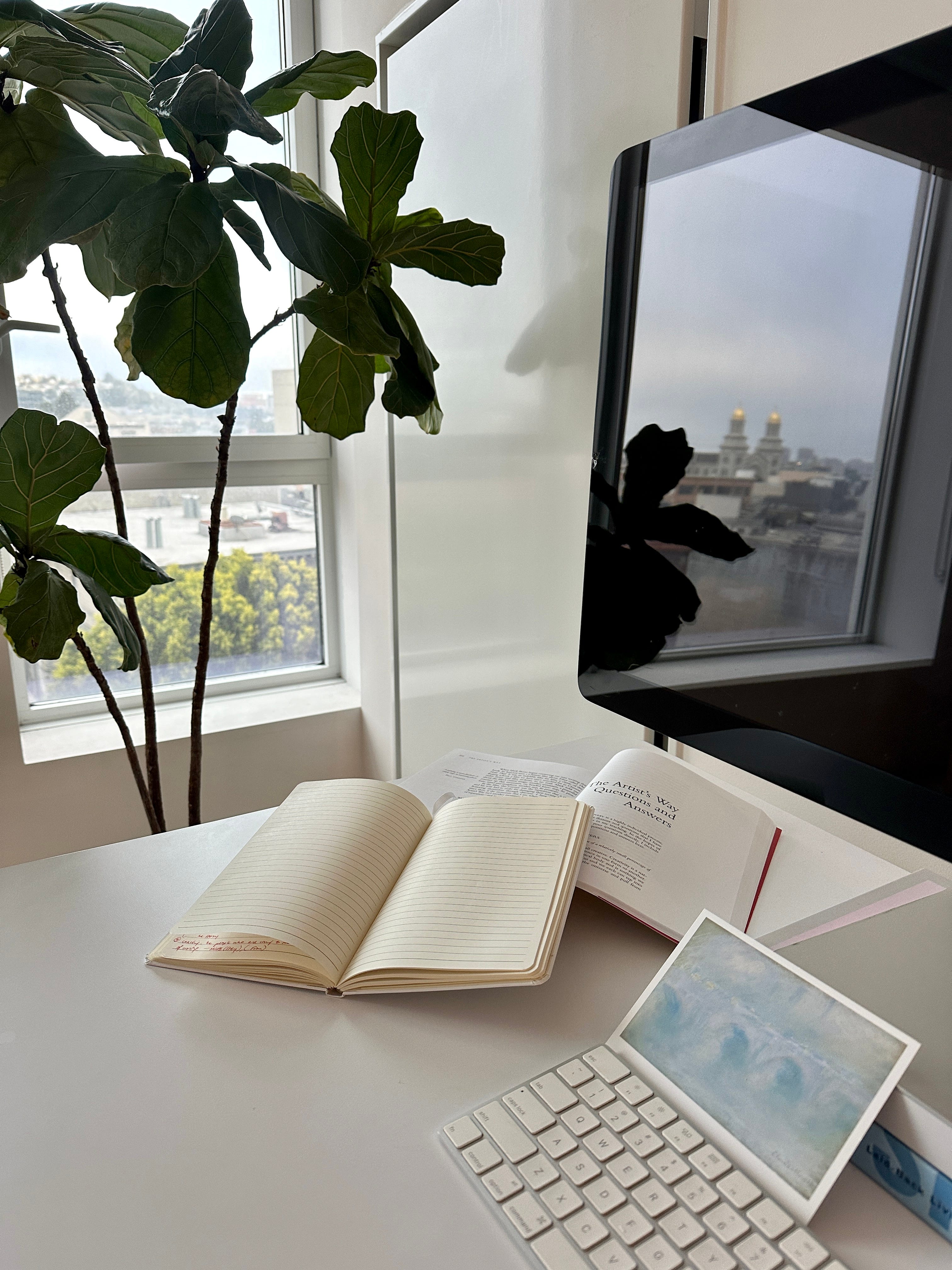
On the page each morning, I can see what steps I need to take, and then off into the day I take them.
Day after day this has formed a process, and it allows me to keep going. Now that I’ve been at it for several months, I can see a new path forming – and this assures me that it’s all working.
I still have questions and doubts, naturally, but I’m not stuck simply wondering. I used to wonder a lot more than I do these days, sitting and contemplating. I’d try to envision a whole future for myself, wondering if it was the right one for me. Now, I just take a step – and it leads me to the next.
I still love contemplation and meditation – don’t get me wrong. Those things have a rightful place in my routine. They just don’t spark action the way that morning pages do for me.
Morning pages interrupt hemming and hawing, the wondering, the stalling…. Each day, once my pages are complete, I jump out of my seat, ready.
Regular writing in my journal also proves to myself that I’m listening. I’ve established a safe space to share what’s on my mind, and I’m ready to listen. This is a relationship I’m cultivating with myself, and the self-trust it generates trickles into the life I live externally.
The exercise of writing three pages by hand in the morning is a cornerstone of the 12-week Artist’s Way program. And the program is having a renaissance moment, I think: more than thirty years after its initial writing, the book is back on bestseller lists. (Maybe it never left; I haven’t checked.)
The number of people I see reading the guide in coffee shops and scribbling in their journals is remarkable to me – and I think it’s because a growing number of us are wanting to live lives of real personal meaning, of creativity and vulnerability and authenticity. One way to do this is to first get close to ourselves and all that lives inside us that’s ready for expression.
Plus, the practices laid out by Cameron work: people across the globe have trusted the program to lift them out of ruts, tear through writer’s block, and start to live more joyfully. Some friends have gone through the 12-week cycle a number of times, generating more and more creativity each round.
If you’re ready to embark on the journey, or to start simply (and profoundly) with morning pages, let this be your inspiration. “A sign from the universe,” as Cameron might say ;)
Related Reading
“I Used to Cringe at Self-Help Books. Until This One Changed My Life.,” the New York Times
“How I learned that creativity and vulnerability go hand in hand,” NPR
I share your sentiment! Morning pages have become such a source of support for me. And a welcome release for all of the "gunk" taking up space in my head :)